
Most of what engineers carefully put into coding agent prompts is now padding, left over from last year's models.1 The prompt usually leaves out what done means for this piece of work, and often the engineer couldn't say.
Here's a prompt an experienced engineer might write for a made-up ticket, "Finance needs to export invoices":
1Read docs/ARCHITECTURE.md before every edit.21. Add an "Export CSV" button to InvoiceTable.tsx.32. Put the export logic in src/invoices/export.ts. Map id, date, customer and total.43. Write unit tests for it.5Double-check your work before you finish, and ask me before making any change you're unsure of.We'd cut most of it, because each of those lines guarded against something last year's models did badly, and today's models from Anthropic and OpenAI mostly handle that part on their own. Their makers' guides now say lines like these waste tokens or slow the work down.2
| Line | What it guarded against | Why we'd cut it now |
|---|---|---|
| A numbered plan, file by file | Losing the thread halfway through | The agent plans its own steps, and a fixed plan gets in its way when the code turns out different |
| "Read ARCHITECTURE.md before every edit" | Missing how the code is organized | It gets read again before a one-line change, which costs time and context |
| "Double-check your work" | Calling it done without checking | Today's models check their own work, so you pay for it twice |
| "Ask me before any change" | Changes you didn't ask for | It can stop the agent partway through work you wanted done |
One exception is a large, old repository, where pointing the agent at the right folder can still save it a lot of searching.
Then we'd add a plain description of done. For the same ticket, it could read like this:
1Finance closes the books on the 3rd of each month and needs the previous month's invoices2in a spreadsheet they can filter.3Done means anyone in finance can download one file for any month from the invoices page.4Each row has the invoice number, date, customer and total. Drafts and credit notes are left out.5The file's total matches the monthly invoice report in the finance dashboard.6Don't change the invoice table's layout.Finding the files and working out the steps is the agent's job. Somebody already decided whether finance wants drafts in the file and which report the total has to match. Usually that's the person who asked for the export, and the engineer who picks up the ticket often hasn't heard their answer. We've argued before that the agent's questions belong to that person.
The author settles what done means before the agent starts
A made-up ticket: "Finance needs to export invoices"
An engineer writes the prompt
- Ticket"Finance needs to export invoices"an engineer reads it
- Engineer's promptFiles, a numbered plan, reminders to checka plan
- AgentGuesses what done means
Cobble asks the ticket's author
- Ticket"Finance needs to export invoices"two questions
- Author's answersDrafts left out, total matches the reportacceptance criteria
- Agent's briefWhat done means, and what to leave alone
That's the part Cobble takes off engineers' hands. Before any code is written on an eligible ticket, Cobble asks its author about whatever is missing. It checks their answers against the code and the team's recorded decisions, and the agent then works to the acceptance criteria that come out of it. For our made-up ticket, one of the questions it would ask looks like this:
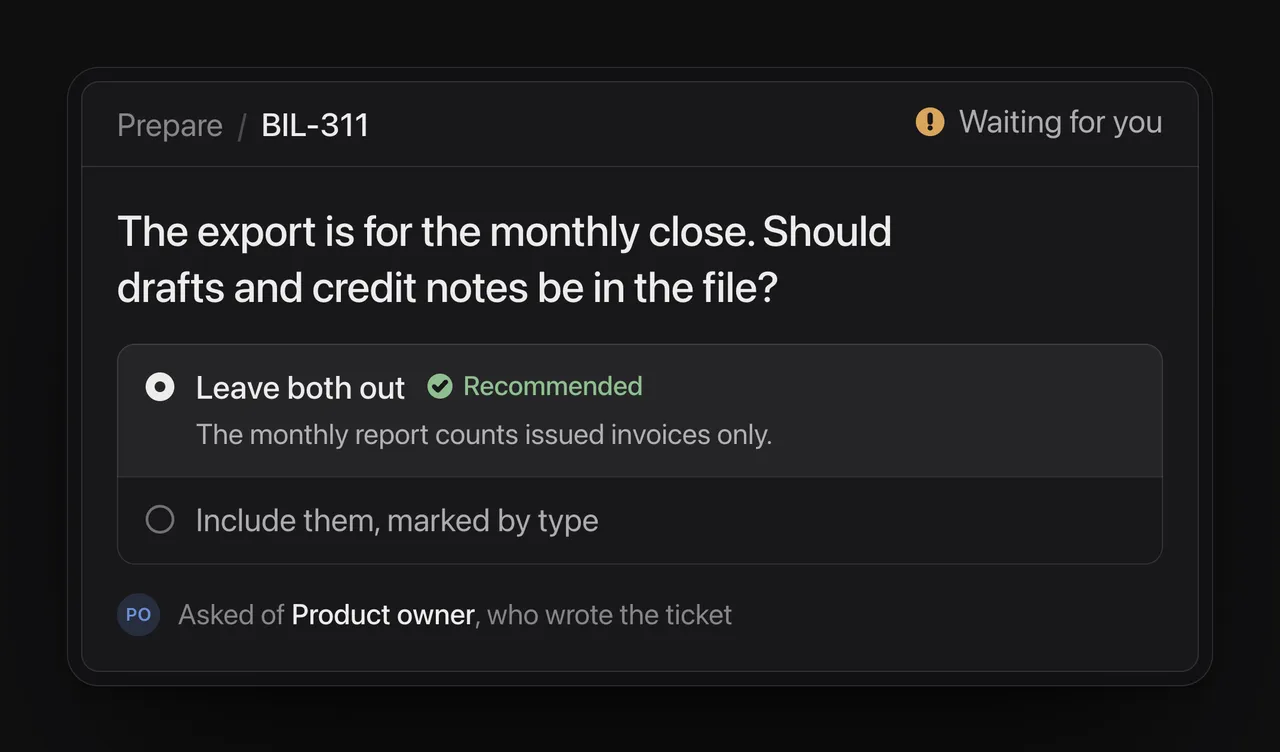
This only works when the author answers. If they're slow to reply, the ticket waits, and we think a short wait costs less than an agent's guess that comes back as rework.
- Theo Browne made a similar point in October 2026 in "Your prompts kinda suck", that engineers overengineer their prompts. Link Back to text
- Anthropic, "Prompting Claude Opus 5" and "Prompting Claude Opus 5.5", Claude Platform documentation, read 27 October 2026; Eric Provencher, "Rethinking skills and prompts for GPT-6 Astra", OpenAI developer blog, 11 September 2026. Anthropic says removing verification instructions "reduces wasted tokens with no loss in quality"; OpenAI, that "prompting the model to read files before every edit is a great way to burn context and slow work down", that "overly specific guidance can now hinder results where it previously helped", and that strong "ask first" wording can make the model "stop work where you'd actually be happy for it to continue". Anthropic, OpenAI Back to text