
If your team pays for Claude through subscriptions, the agent harness you run is Claude Code. We think that's the right harness to be on anyway. A team's own effort pays off more in how work reaches the agent and how the result gets checked.
A harness is the code that turns a language model into an agent. The model can only write text, so the harness gives it tools, like reading a file or running a command, and runs the calls the model writes, passing back what came out.1
The harness runs the model's tool calls
One turn of the loop
The call
- ModelWrites read_file("invoices.ts") as texta tool call
- HarnessSpots the call and runs itruns the code
- Your machineOpens the file
The result
- Your machineThe file's contentsthe output
- HarnessPasses them backas text
- ModelReads them, writes the next call
Anthropic's terms don't let other apps route requests through a Claude subscription. OpenCode, an open-source harness, took its Claude sign-in out on 19 March 2026.2 Another harness still works with an API key, but then you pay for every token on top of the subscription.
Claude Code itself had more than twenty releases in October 2026.3 A harness a team writes itself, or a third-party one like OpenCode, has to keep up with that pace. Anthropic also tunes Claude Code for its own models as they come out, so the official harness is usually the first to get the most out of a new one.
On one of our projects, each engineer set up their own way of handing work to the agent and checking what came back, with their own tools and prompts. The results varied with the engineer.
A team's process sits on top of the harness
Your team owns
- Which workEligible tickets from your trackerpicked up
- The briefWhat done means, from the ticket's authorbuilt to it
- The checkA second agent, then your merge rules
The maker provides
- HarnessClaude Code or Codex, unmodifiedruns
- ModelClaude or OpenAI's models, on your subscriptions
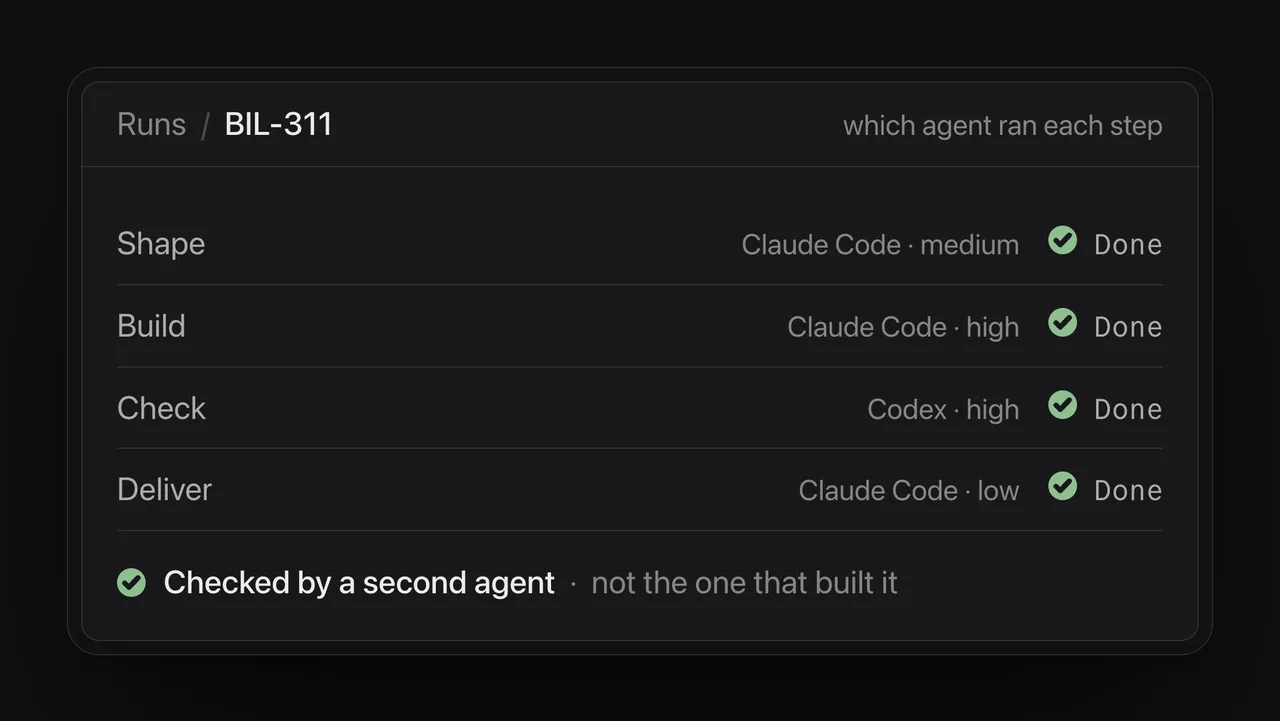
That's the part Cobble writes down once for the whole team. It runs Claude Code and Codex unmodified, on the subscriptions a team already has, because a harness of our own would mean chasing those releases ourselves and teams paying per token for it. Cobble takes eligible tickets from your tracker, and before the agent starts on one, it asks the ticket's author about whatever is missing. A second agent checks the work before the pull request opens.
If Anthropic ever let subscriptions run in any harness, or stopped shipping its own, we'd look at this choice again.
- Theo Browne's article "What is a 'harness'?" on X (23 October 2026) is the clearest longer explanation we know of, including how an app and its harness come apart. Link Back to text
- Anthropic, Claude Code documentation, "Legal and compliance", read 27 October 2026: it "does not permit third-party developers to offer Claude.ai login into their own applications, or to route requests through Free, Pro, or Max plan credentials on behalf of their users", and signing in to the unmodified Claude Code with your own subscription is allowed. OpenCode's pull request 18186, "anthropic legal requests", was merged on 19 March 2026. Anthropic, OpenCode Back to text
- Claude Code's releases on GitHub (anthropics/claude-code): 23 stable releases between 1 and 26 October 2026. Link Back to text