
In May, Anthropic merged about 2,500 code changes a day. By September it was over 30,000. Git couldn't keep up, so a team of seven built their own source control system, called Scion, and moved the company's monorepo onto it in five months. Their engineering post opens like this.1
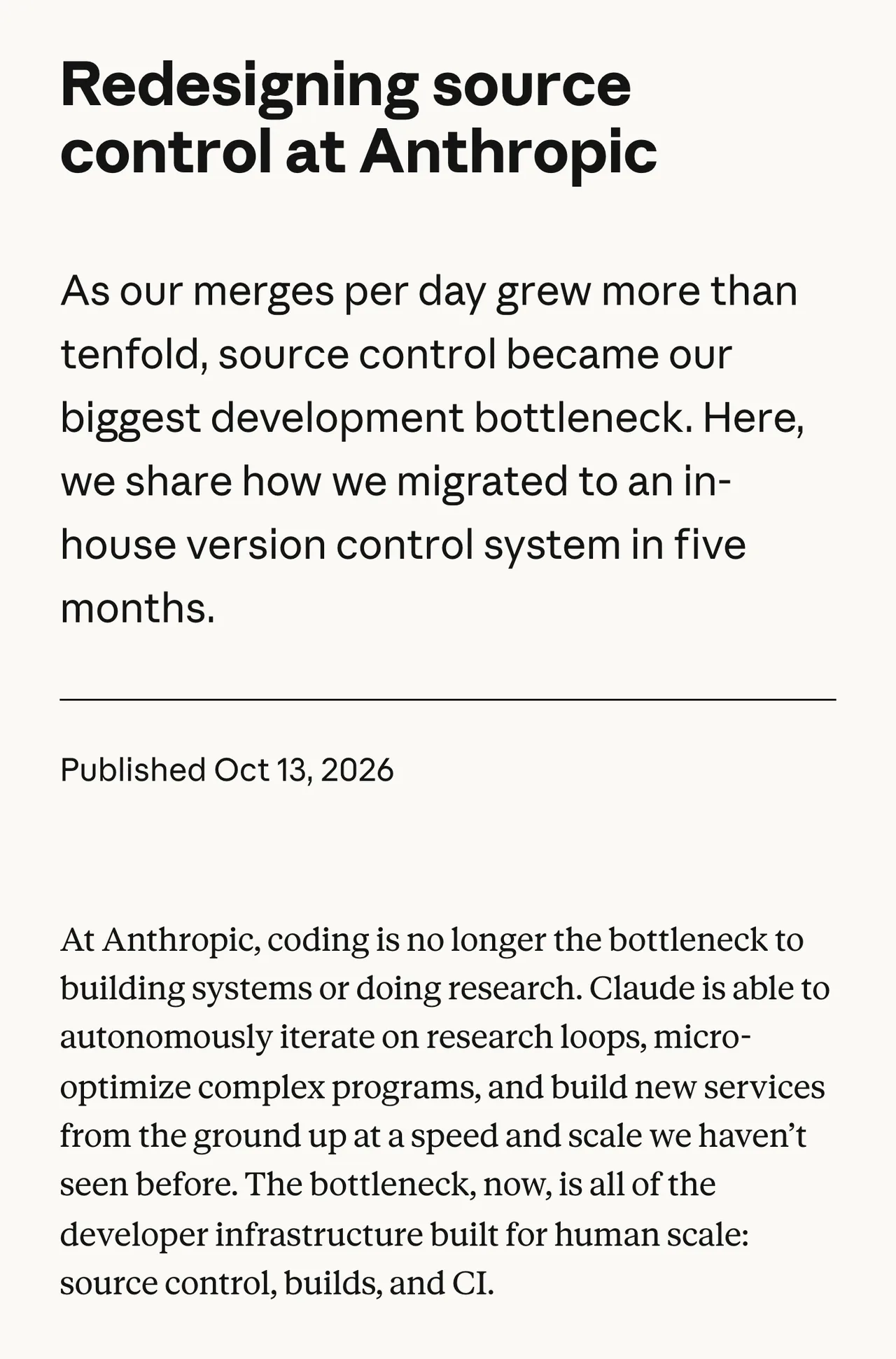
You probably don't need Scion. Anthropic says so too, writing that the ideas "only make sense for truly enormous monorepos". We think where AI work piles up tells you how far a team has got, and a merge path that can't keep up is a problem you reach late.
Each bottleneck you clear sends more work to the next
Right after that opening, Anthropic writes that "the latent demand for merging code is practically infinite, and every bottleneck we remove immediately leads to a further increase in the amount of code we produce." So the pile-up moves to the next step that can't keep up, and we think the steps come in a rough order. Anthropic is one company with an unusual workload, so your steps may come in a different order.
Some of the load arrives at once. Every pull request needs a checkout and a build, so CI feels agent volume as soon as agents start opening pull requests. At Anthropic's size that meant on the order of 25 million checkouts a day for CI alone. Teams usually fix it early, with more machines.
The merge path is different. A change reaches main and the merge queue only after someone, or some rule, approves it. It can't fill faster than approvals come out. We'd stretch Anthropic's phrase "built for human scale" to cover the approvals too, because those are where we think agent work usually waits: on a person working out what a vague ticket meant, or on a reviewer reading every line of every change.
Anthropic rebuilt review as well as git
The team that built Scion still reviews every change to it, but they "now examine the intent of the change as opposed to reading every line of code." The same seven people built a code review tool, Antique, whose approval rules can tell a change that only touches comments from one that changes sensitive logic. We read that as approval catching up with the agents, which is what lets merges climb far enough to break the merge path.
It broke on a rule built for human scale. The industry standard, as Anthropic calls it, is a global lock on the merge queue. At their volume they write that they "haven't been able to effectively replicate" it, so they test after merge and before deploy, and let the agent fix the conflicts. It suits their scale. We wouldn't copy it at a bank.
In the company data behind our post on the review bottleneck, agent pull requests waited for reviewers, and work reaching production didn't grow by a measurable amount. Those firms were stuck before the merge queue, so speeding it up wouldn't have reached their waiting work.
We built Cobble for the steps before it. An agent interviews the ticket's author about a request before any building starts, a separate agent checks the result, and the evidence goes on the pull request. Each team decides whether a person approves before merge.
Find the step your agents' work waits on
Take your last few agent pull requests and look at where each sat longest: on a question about the ticket, in a reviewer's queue, or approved and waiting to merge. If they waited for a person, a faster merge path won't help yet. Spend on clearer requests and on what reviewers get to decide from. If they waited to merge, you've already done the hard part, and Anthropic's post is worth reading closely.
- Nick G. and the source control team, "Redesigning source control at Anthropic", Anthropic engineering blog, 13 October 2026. https://www.anthropic.com/engineering/redesigning-source-control. The merge counts (about 2,500 a day in May 2026, over 30,000 a day in September), the 25 million checkouts a day for CI (before developer environments, agent sandboxes and research jobs), the team of seven, the five months, Antique and the quotes are from that post. The review quote describes the team that built Scion, not all of Anthropic. Back to text